How many solar panels do I need for my home? 2026 guide
Most homes need 16-23 solar panels to ditch their electric bill. Here's how to find your magic number.
Staring at your electric bill and wondering how many solar panels it would take to make it disappear? Yeah, it's one of the first questions every homeowner asks when they start thinking about going solar.
Honestly, there's no one-size-fits-all answer to the question, "how many solar panels do I need for my home?" Even if your houses look identical from the street, your neighbor might need 18 panels while you need 22. Your electricity usage, roof space, and location all play starring roles in this calculation.
Thankfully, you don't need an engineering degree to figure this out. We'll walk you through a straightforward calculation that gets you a solid estimate using just your electric bill and a few basics about your home. If you have your electric bill handy, that'll give you the most accurate starting point. If not, we'll use national averages to get you in the ballpark.
Ready to crunch some numbers and see what solar independence looks like for you?
Most homeowners save around $60,000 over 25 years
- Vetted installers
- Unbiased advice
- Completely free
Key takeaways
An average home needs between 16 and 23 solar panels to fully offset its annual electricity use
The number of solar panels you need depends on three things: your electricity consumption, geographic location, and the wattage of your panels
If math isn't your thing, use our Solar Calculator to find out how many panels your home needs
To estimate how many solar panels you need, divide your yearly electricity usage by your area's production ratio, then divide that number by the wattage of your solar panels.
To put it simply:
Number of panels = annual electricity usage / production ratio / panel wattage
For example, 16 to 23 panels = 10,791 kWh / 1.6 or 1.1 / 440 W
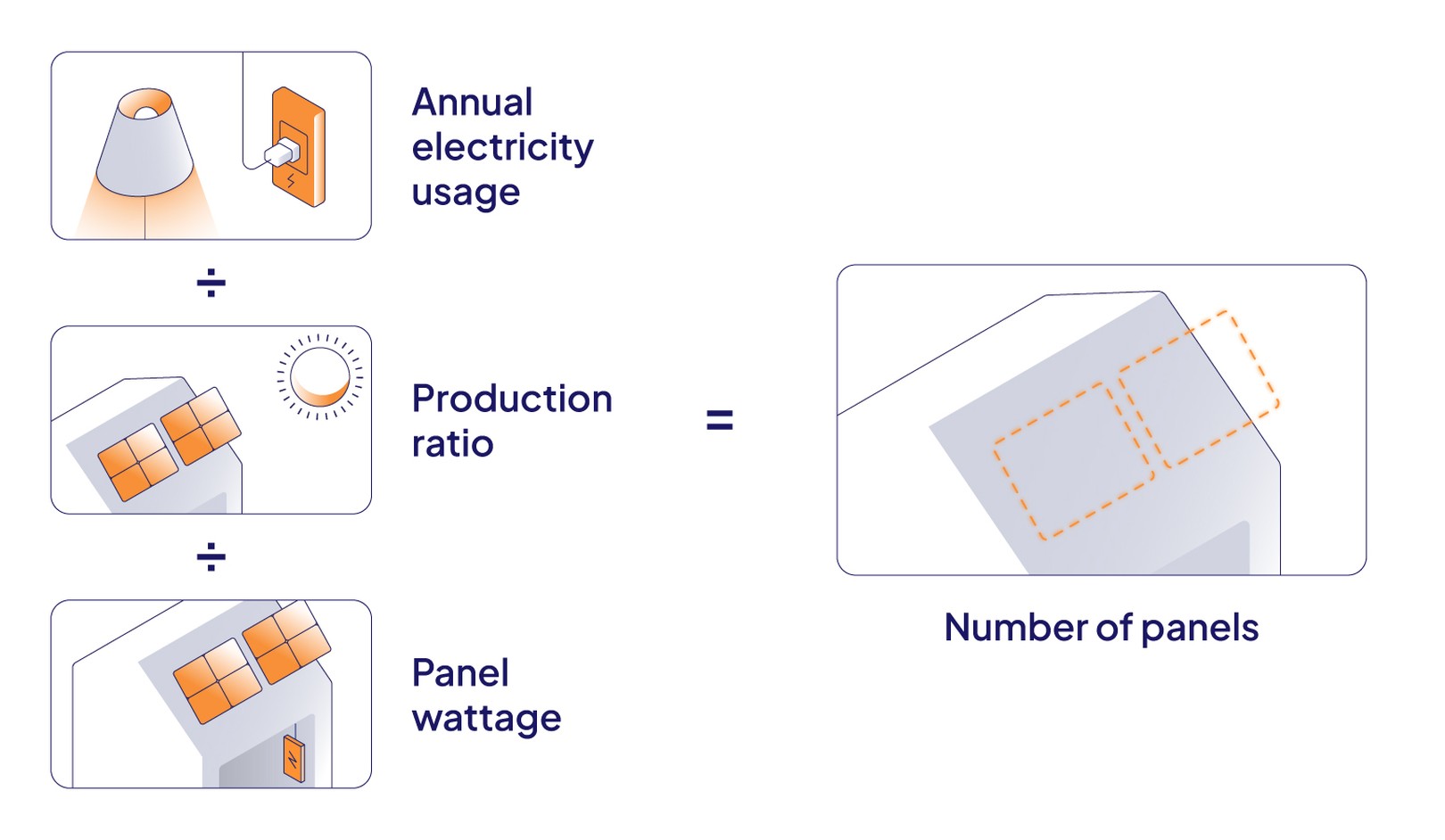
Here's what each of those inputs actually mean:
Now that we have our three main inputs (energy use, solar panel wattage, and production ratio), we can use this formula to turn them into panel count:
Number of panels = annual electricity usage / production ratio / panel wattage
Plugging our numbers in from above, we get:
Number of panels = 10,791 kWh / 1.1 or 1.6 / 440 W
…which gives us between 16 and 23 panels in a solar panel system, depending on which production ratio we use (16 for a 1.6 ratio and 23 for a 1.1 ratio). If we use California as an example (average production ratio of 1.5), you'll need about 17 panels, resulting in a system size of 7.5 kW.
Solar panel cost
Now that you know how many panels you need, you might be wondering about cost. On average, solar panels cost $2.60 per watt. For a 12 kW system (the average quoted system size on EnergySage), you're looking at about $31,135 before any available incentives.
Of course, solar costs vary widely depending on location, installation cost, and availability of state and local incentives.
The three inputs above will give you a solid estimate of how many solar panels you need, but there are many other factors that can determine your perfect solar panel system size. Your local sunshine, the system sizes installers typically quote, your household habits, your roof, and the size of your home all play a part.
How much sunlight does your roof get?
The amount of electricity (kWh) your solar energy system can produce depends on how much sunlight hits your roof, which creates your production ratio. That depends on where you live and the time of year.
California, for instance, gets a lot more sun per year than Massachusetts, so a Massachusetts home needs a bigger solar panel system to produce the same amount of energy. Take two households, one in California and one in Massachusetts, that both use the average amount of electricity (10,791 kWh), annually and want to offset their use entirely.
The California home (production ratio of 1.5) needs about 17 panels, or a 7.5 kW system.
The Massachusetts home (production ratio of 1.1) needs about 23 panels, or a 10.1 kW system.
Both homes can cover their electricity use with solar. The Massachusetts home just needs six more panels to do it. If you live somewhere less sunny and your roof space is tight, high-efficiency panels can help you squeeze more electricity out of every square foot.
What size solar panel system do you need?
The table below shows how many 440 W panels it takes to build some of the common system sizes we see on the EnergySage Marketplace. We're using a production ratio of 1.5 for this example, which is realistic for much of California. If you live in the Northeast or another less sunny area, expect each system to produce less electricity than shown here, which means you'd need more panels to cover the same usage.
Number of solar panels needed for specific system sizes
System size | Number of panels needed* | Estimated annual production |
|---|---|---|
| 4 kW | 10 | 6,000 kWh |
| 6 kW | 14 | 9,000 kWh |
| 8 kW | 19 | 12,000 kWh |
| 10 kW | 23 | 15,000 kWh |
| 12 kW | 28 | 18,000 kWh |
| 14 kW | 32 | 21,000 kWh |
*Assumes 440 W solar panels and 1.5 production ratio.
How much electricity do you use?
One of the most challenging parts of sizing a solar panel system is estimating your household's annual energy usage. Larger consumer products or add-ons can significantly change your annual kWh requirements and impact how many panels you will need.
For example, if you're running central air conditioning, powering a heated swimming pool in your backyard, or regularly charging an EV, the size of your solar panel array may need to be drastically altered. To get a feel for the size you'll need, think about the energy impact of all of your household products you own or are considering for your home.
How much roof space do you have?
Ultimately, you'll only be able to install as many panels as you can fit on your roof. Below is a table that will give you a sense of how many square feet your system will take up on your roof, depending on the power output of the solar panels you select.
Square footage of different-sized solar panel systems
System size | 400 W panels (sq. ft.) | 420 W panels (sq. ft.) | 440 W panels (sq. ft.) | 460 W panels (sq. ft.) |
|---|---|---|---|---|
4 kW | 210 | 210 | 210 | 189 |
6 kW | 315 | 315 | 294 | 294 |
8 kW | 420 | 420 | 399 | 378 |
10 kW | 525 | 504 | 483 | 462 |
12 kW | 630 | 609 | 588 | 567 |
14 kW | 735 | 714 | 672 | 651 |
16 kW | 840 | 819 | 777 | 735 |
18 kW | 945 | 903 | 861 | 840 |
20 kW | 1,050 | 1,008 | 966 | 924 |
The table above assumes each panel takes up about 21 square feet. Actual panel sizes vary by brand and model, and installers also need to leave space around roof edges, vents, and chimneys, so plan on needing a bit more room than shown.
If your home is small or if your roof has an unusual shaped, you need to pay more attention to power output and efficiency when choosing solar panels. With a large roof, you can get away with choosing less efficient solar panels because you have more space for more panels. But if you have a smaller roof, you need to maximize your space, so we recommend choosing more power-dense, high-efficiency panels, like those from CW Energy, Maxeon, SEG Solar, or Silfab
 Some solar panel companies have even reduced the size of gaps between panels and use invisible framing and mounting hardware to keep the panels tight, efficient, and aesthetically pleasing.
How big is your home?
Check out the table below for a ballpark estimate of how many solar panels your home would need based on its square footage (assuming 440 W solar panels and a production ratio of 1.5).
Home square footage compared to the number of solar panels needed
Home size | Estimated annual electricity needed | Number of solar panels needed |
|---|---|---|
| 1,000 sq. feet | 4,710 kWh | 8 |
| 2,000 sq. feet | 9,420 kWh | 15 |
| 2,500 sq. feet | 11,775 kWh | 18 |
| 3,000 sq. feet | 14,130 kWh | 22 |
Reviewing the various kWh requirements for everyday household appliances and products, one thing is clear: Specific add-ons will dramatically change your monthly energy use and can impact the size of the solar panel system you should install. For example, pairing your electric vehicle with solar panels is a great way to reduce carbon emissions and improve energy efficiency. But it could double the size of your solar panel system.
It's certainly possible to install a solar panel system and then add more panels later to accommodate increased energy needs. However, it's easier and cheaper to size your system as accurately as possible based on your expected purchases such as heat pumps, an electric vehicle, or a swimming pool. Asking yourself, "How many solar panels will I need for my refrigerator, hot tub, EV, etc." is an excellent exercise for any new solar homeowner.
Solar panel requirements for individual appliances
Product | Average annual electricity needed | Number of solar panels needed |
|---|---|---|
Refrigerator | 650 kWh | 1 |
Window air conditioner (one unit) | 215 kWh | 1 |
Air conditioning (average home that uses it) | 2,300 kWh | 4 |
Heated swimming pool | 2,500 kWh | 4 |
Electric vehicle | 3,000 kWh | 5 |
Hot tub (outdoor) | 3,300 kWh | 5 |
The table above assumes 440 W solar panels and a 1.5 production ratio. Refrigerator figure based on the EIA's household survey; air conditioning figure estimated from EIA cooling data.
Getting the number of panels right isn't just about covering your next electric bill—it's about building a system that works for your household for the next 25 years. Order too few panels and you'll still be paying your utility every month. Size your system too large and you'll overspend on equipment you don't need.
The beauty of solar is that once you've determined your number, your panels will continue to do the same reliable work year after year. No more monthly bills to dread or electric rate increases to stress about. Just clean electricity flowing from your roof, powering your home the way you need it to.
Whether you land on 16 panels or 23, you're making a decision that reshapes how you power your life for decades. And that calculation you just learned? It's the first step toward energy independence that actually sticks.
Most homeowners save around $60,000 over 25 years
- Vetted installers
- Unbiased advice
- Completely free
Plug in for monthly energy-saving tips, climate news, sustainability trends and more.

Related articles
How many solar panels do you need to charge an electric car?
Written by Spencer Fields
Oct 21, 2026
5 min read

Avoid peak rates and keep your essentials running, even when your street loses power.
